
West New York Previous Residents by Era
Era matters when you hunt past residents. Different periods call for different sources. The recorded-land trail can start online. But the Hudson Register's date picker is only an interface range. It does not promise that every old index or image is available remotely. The State Archives, library, museum, and federal census take over further back. Each source answers a narrower question than a single name search. You get recorded parties, a printed household clue, or a census-place relationship. A map's street context comes one piece at a time.
| Source | Years it covers | Where held | What it shows |
|---|---|---|---|
| Hudson Register Acclaim picker | Dec. 31, 1774 through current date in the interface | Online and Register | Party, document, and legal-description routes; verify actual availability. |
| County deed microfilm | Deeds through 1900; indexes may continue later | New Jersey State Archives; originals remain county-owned | Historic grantor/grantee and book/index fallback. |
| North Hudson directories | 1902-03, 1905-06, 1916-17, 1922-23 confirmed | NJ State Library Reels 35-36 | Regional name/address cross-check, if printed. |
| Federal census | Complete public schedules through 1950 | National Archives and library routes | Household and census-place correlation. |
| New Jersey state census | 1855-1915 | State Archives | Interim family and locality context. |
| Hudson naturalizations | 1840-1948 | State Archives | Name and locality transition clues. |
| WNY Museum maps | Exact years not published | Library Museum | Historic property and street-plan context. |
Begin with the most recent documented transfer for a property question. Then step back to the older source. The Town has published no verified residence-history guide and no local Sanborn run. No town-wide renumbering date exists either. Note: A source's date span shows where to look next, not proof that it identifies a prior household.
Anchor Previous Residents to a Parcel
Start with the address written exactly as the source document shows it. Then find the matching block and lot on the Town tax map. The Town Tax Department also links the WIPP tax inquiry. It is a dynamic lookup for local parcel records. For a wider view, try the statewide Property Explorer. It searches by address, county, municipality, block, and lot. Keep both the everyday street form and the block/lot pair in your notes. One address can be formatted several ways, while the land description stays the stronger anchor.
Property Explorer shows parcel geography. However, owner names are redacted in hosted data under Daniel's Law. WIPP runs on JavaScript. So expect an interactive page rather than plain records. For current local guidance, call the West New York Assessor at (201) 295-5115. An assessed or recorded owner can open a chain of past residents. Remember the limit, though. An owner mailing address tells you where tax mail goes. A property situs never proves that a person actually lived there.
Follow West New York Previous Residents Back
The Acclaim name search and its legal-description search at the Hudson County Register are the recorded-document paths. Together they support a backward chain. Acclaim offers several modes. Name, Book/Page, Instrument Number, Legal Description, Doc Type, Consideration, and Record Date all appear. The name route takes All, Grantor, or Grantee and displays last name, first name. At least three characters are required. A party name can appear in several unrelated transactions. In that case the legal-description route is the better check.
- Use the parcel details to find the most recent recorded deed or instrument tied to that legal description.
- Record the grantor, grantee, document type, recording date, consideration when shown, and instrument number or book/page.
- Search the current grantee as a grantee to locate that party's acquisition record.
- Use the earlier grantor as the next recorded-party lead, checking the legal description and municipality at every link.
- Repeat with spelling variants, then move to the Register counter or archive records when remote detail is not enough.
- Grantor
- The party conveying or transferring an interest in a recorded document.
- Grantee
- The party receiving that recorded interest. The role is evidence of a transaction, not a statement about who occupied the property.
- Chain of title
- A documented sequence of recorded transfers connected by the same legal description.
- Legal description
- The land identifier used in recorded documents. It can be more stable than an older street form.
When Previous Residents Go Offline
An online gap does not end a deed trail. The Hudson Register's Public Search Room keeps computer and hard-copy indexes, deeds, mortgages, lis pendens, and filed maps. The room sits at 257 Cornelison Avenue, 2nd Floor, Jersey City. Public-search and cashier hours run Monday through Friday, 9:00 a.m. to 2:00 p.m., with telephone customer service listed from 8:00 a.m. to 3:45 p.m. Visitors may view and copy records there. Photographs are not allowed. The office number is (201) 395-4760.
Use the Hudson Register property search and Public Search Room page for the counter route. Regular copies cost $0.05. Computer prints run $0.07. Certification runs $10 for the first page plus $1.50 for each additional one-sided page. Those figures help plan a document request, though access to a particular record still depends on the custodian and the document detail.
Online work sometimes stalls. The in-person indexes cover that gap. For older deed work, the State Archives reports county deed microfilm through 1900 and deed-index microfilm that may extend later.
Pair West New York Past Residents
Recorded parties and past residents differ. Document the parcel and deed trail first. Only then add the household layer. The confirmed North Hudson directory checkpoints are 1902-03, 1905-06, 1916-17, and 1922-23, and each covers West New York in regional scope. No continuous directory run exists. A printed address can be compared with the nearest released federal census or New Jersey state census context. Then test it against the property's legal description and maps.
- Keep the deed year, document reference, legal description, and street form on a single worksheet.
- Inspect the nearest confirmed North Hudson directory issue without assuming fields that the page has not shown.
- Pair the directory date with a released census and keep the municipality label used by that source.
- Use obituary, newspaper, vital, probate, or naturalization material to test a name variant or transition.
- Return to the parcel record before connecting a household clue to the address.
The West New York city directory collections page details the four confirmed directory issues. Reel-inspection limits are covered there. A household entry can corroborate a carefully dated address connection, but it cannot replace a documented land trail.
West New York Maps and Past Residents
Older West New York properties often need more than a current address. The WNY Museum is the place to start. It sits on the second floor of the Public Library. Its holdings include hundreds of vintage property and street-plan maps. Town Historian Patrick Cullen handles simple historical research at (201) 295-5135 ext. 7308 or pcullen@westnewyorknj.org. When you contact him, bring the address wording. Add an approximate period. Include a surname only if already documented, and the block/lot or legal description where known.
The museum's map work sits inside a longer local chronology. The West New York town history lays out that chronology. It also covers the predecessor jurisdictions behind it. A map can make a street-plan relationship visible. It cannot supply a verified town-wide renumbering date. Nor does any single map establish a home-by-home timeline for past residents.
A vintage map works best beside a parcel's legal description and an exact dated record, not as a stand-in for either one.
West New York Previous Residents Catalog
The West New York Public Library gives researchers a strong catalog and referral route. Its Polaris catalog supports Keyword, Browse, Phrase, Exact, Advanced, and Boolean searching. For an exact author search, use the last name first. The * and ? wildcards both work. Try directory names such as Wand, Polk, and North Hudson. Then add West New York, Union Township, North Bergen, or Bergenline. Pick the term the record date suggests.
Open the West New York Library Polaris catalog. Use it to identify a holding or to shape a reference question. The Library also points to historical maps, business directories, and newspapers. It lists JerseyCat, JerseyClick, and statewide interlibrary lending for eligible cardholders. State Library Cyber Desk referrals cover genealogy, Jerseyana, and Archives questions. No local residence-history guide exists there. The catalog and referral network still make it a practical stop.
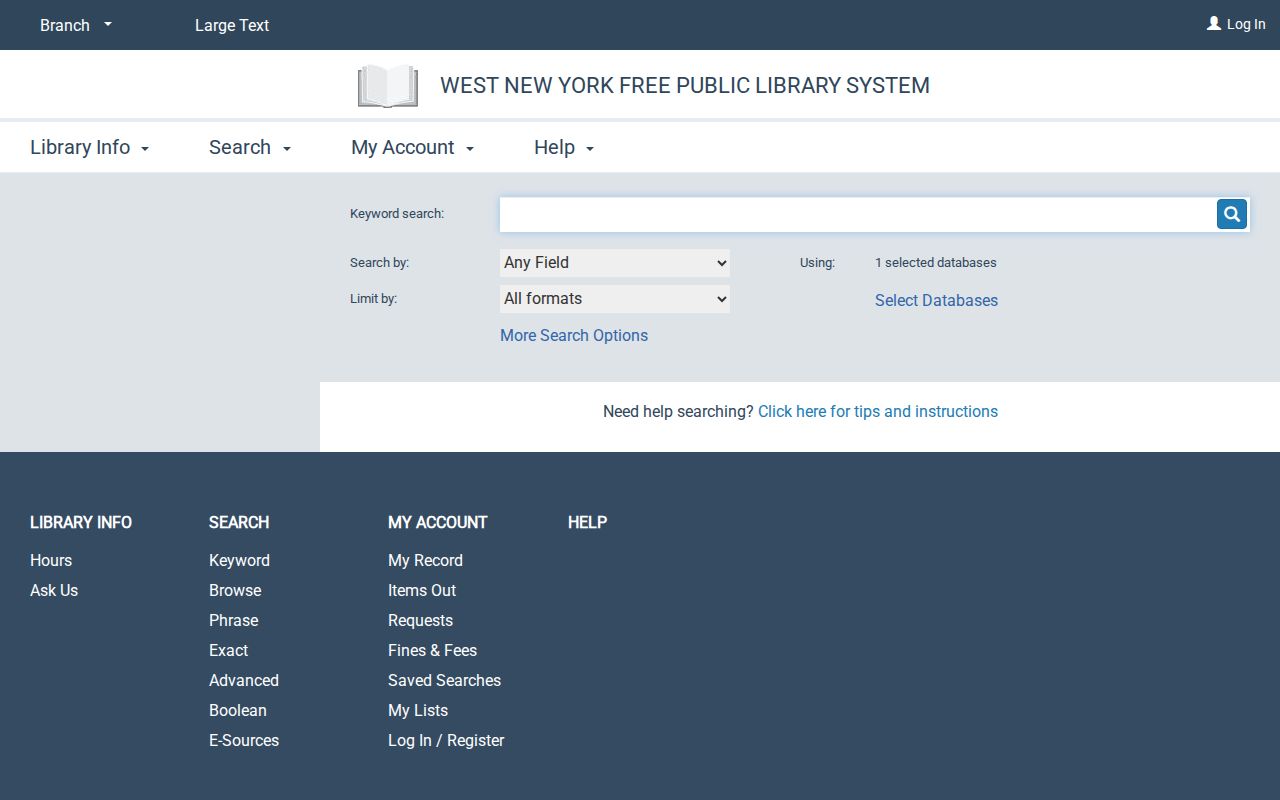
Treat the catalog as a planning tool for past residents research. Confirm any reel, book, microform, or access route with the reference desk before counting a catalog entry as an available address record.
Previous Residents Before West New York
West New York gained official recognition in 1898. Before that, the same geography belonged to a sequence of other jurisdictions. Bergen Township covered the area from 1798 to 1843. North Bergen Township followed from 1843 to 1861. Union Township held it from 1861 to 1898. Use those labels in deed, census, probate, newspaper, and catalogue searches for past residents. The first traced geographic reference to West New York appears on an 1854 Hudson County map, so an older source may carry a different place name for the very same ground.
Recent redevelopment notices from the Town show why a block/lot belongs beside every street address. One 2026 notice paired 6120 Buchanan Place with Block 40, Lot 5. Another paired 6600 Hillside Road with Block 167, Lot 1.02. These are contemporary parcel examples only, not evidence about prior residents. Note: Never force an old place name or a modern address into one chain without a matching legal description or other documented link.