
West New York Neighbor Sources
West New York block research is best done through parcel adjacency. The first task is geographic: connect the focal address to its block and lot, identify visible adjoining parcels, then ask a separate records question for each lot. The method does not produce a household list. It distinguishes the land next to an address from a person who may own, receive mail for, visit, or live at that land. The same limit applies across West New York property, court, and municipal sources.
| Block source | What it can show about a West New York block | Access and limit |
|---|---|---|
| Town tax map | Street, block, and lot layout | Public map anchor, not people data. |
| NJGIN Property Explorer | Parcel polygons, identifiers, address geography, and visible adjoining lots | Free map; hosted owner names are redacted and no buffer tool is documented. |
| WIPP or Assessor | Local assessment and tax-account context for one parcel | Dynamic portal or Assessor counter; not an occupant list. |
| Hudson County Register | Recorded party and document history for one legal description | Repeat the search for each lot; a transaction is not current presence. |
| Building or Code | Existing address-specific property files | Specific record request; no public online case index was found. |
| Community programs | Public meetings and participation contacts | Public, opt-in contact points, not private rosters. |
West New York property geography remains the stable starting point even in a dense area. Keep the street address beside the block and lot in every note. That pair is more reliable than assuming a name, a mailing field, or one map label identifies all nearby people.
West New York Parcel Neighbors
Begin with the West New York tax map or the Town’s tax path to stabilize the address. The map connects streets to municipal block and lot numbers. Next, use New Jersey Property Explorer with the address, or with Hudson County, West New York, block, and lot. The selected parcel gives geography and the nearby polygon pattern. It is a visual starting point, not a survey and not a people search.
Write down the identifiers for the visible adjoining lots. Then check each parcel one at a time through the Town-linked WIPP tax inquiry, the Assessor, or the Hudson Register’s Legal Description route. WIPP is a JavaScript application with documented block, lot, qualifier, owner-name, property-location, and tax-account routes, but display details can vary. The Assessor can explain the current local record or copy procedure at (201) 295-5115. A mailing address, if lawfully visible, can differ from the parcel location.
Note: West New York neighbor research uses visible parcels as leads and should always retain the block, lot, and source date.
West New York Neighbor Comparison
Official West New York records and commercial neighbor products are not interchangeable. The official path exposes a particular record class and its limits. An unofficial product may combine old or mismatched information without showing which custodian supplied it. Compare the original parcel, register, or municipal record before relying on a name. Most importantly, neither category turns an address into a verified household list.
| Route | Useful West New York question | Key limit |
|---|---|---|
| Tax map and Property Explorer | Which lots are visibly next to the focal parcel? | Polygon context is not a survey, household list, or protected-name disclosure. |
| WIPP, Assessor, or Register | What assessment or recorded-document context exists for one lot? | Mailing, party, or owner fields do not prove who occupies the site. |
| Commercial neighbor tools | A possible lead to compare with a custodian record | Date, source, identity, and address accuracy may be unclear. |
The State map is rich in parcel context but redacts owner names under Daniel’s Law. That is a protection, not a missing feature. West New York block relationships can be studied responsibly by moving from map identifiers to lawful records, never by attempting to defeat redactions.
Map West New York Neighbors
Use a parcel-by-parcel flow for West New York block research. The sources reviewed do not document an adjacent-parcel command, radius search, buffer, mailing-label tool, or whole-street function in Property Explorer. The defensible approach is to inspect only the polygons visibly touching or bordering the selected parcel, compare them with the Town tax map, and search each confirmed lot separately. Do not describe a parcel as adjacent until the records agree on the relevant block and lot.
- Find the West New York address on the tax map or in Property Explorer and record the focal block and lot.
- Select the focal polygon and note the visible adjoining parcel identifiers.
- Compare those identifiers with the tax map before treating a lot as adjacent.
- Use WIPP, the Assessor, or Hudson Register Legal Description search for each separate lot.
- Keep the source, date, document type, and the limited fact each record supports.
For the wider record trail along a named road, use the West New York streets page. Its address chain is broader than an immediate-neighbor question and should remain separate from this block method.
West New York Voter Limits
The New Jersey Voter Information Portal is a personal registration-status and polling-information tool, not a browseable West New York neighbor list. Its dynamic form was not documented with personal data, so no live form fields are assumed here. The portal cannot be used to build a block list. Voter status also reflects an administrative maintenance cycle rather than a direct statement of every person at an address.
New Jersey law separately permits a county-provided statutory registry list under N.J.S.A. 19:31-18 and 19:31-18.1, subject to permitted-use rules and protected-address exclusions. Hudson County’s official election offices, not the self-check portal, handle that request path. The list does not supply ballot choices, and no West New York block claim should be made from an excluded, protected, or unverified record.
West New York Block Files
West New York Building and Code Enforcement can hold property-specific permits, certificates, compliance documents, inspections, or notices. No official public online permit or code-case index was found. A useful request is narrow: give the street address, block and lot, record class, and date interval. Building, Zoning, and Code Enforcement coordinate the relevant local property channels. Building’s main number is (201) 295-5170, while Code Enforcement is listed at (201) 295-5174.
The West New York Code Enforcement page is the source for the office contact route shown below.
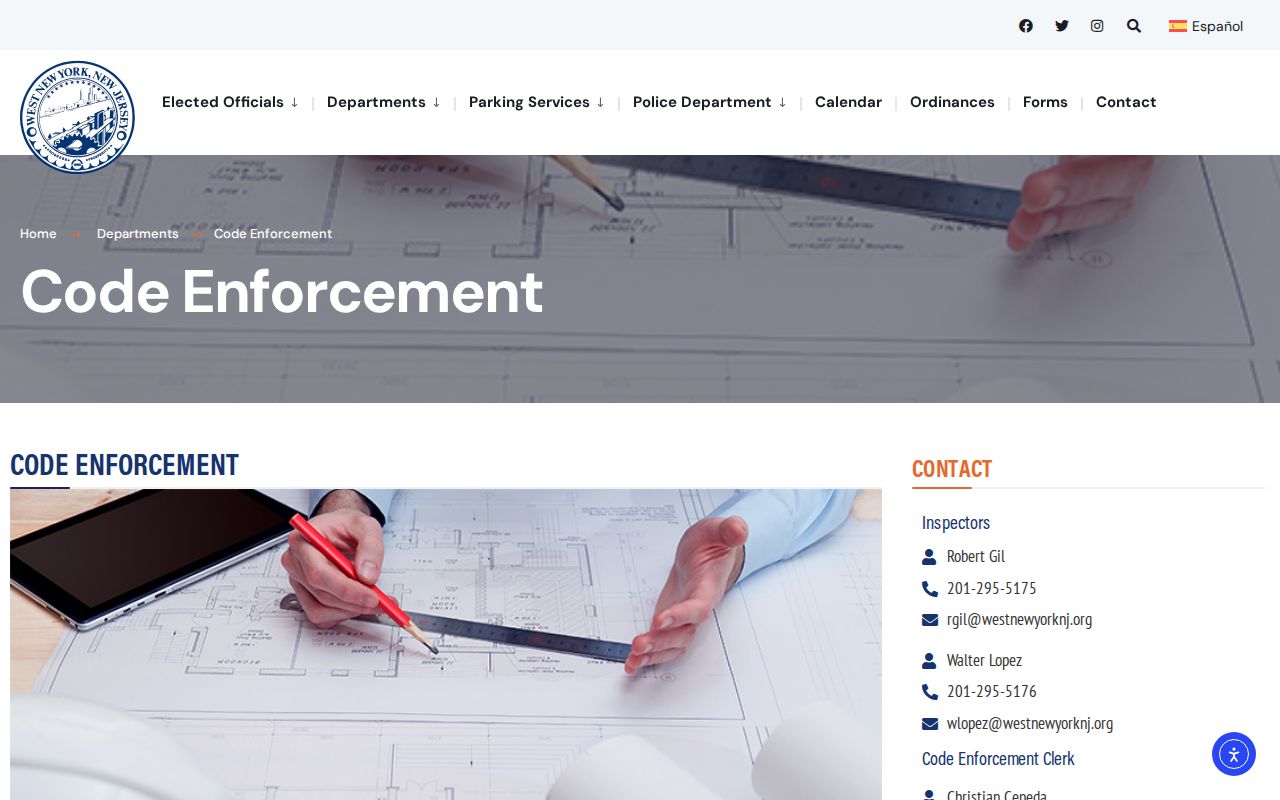
A West New York block file can date work on a parcel or identify a field that the retained record actually contains. It cannot establish all occupants, private utility accounts, or an entire household set. Use the Town Clerk’s OPRA route for an existing identifiable municipal record when a department does not provide it online.
West New York Civic Contacts
No Town-operated neighborhood association, HOA, block-watch, or umbrella member directory was located. That absence is a useful boundary for West New York block research. Public civic contacts are available, but they are opt-in programs rather than household lists. The Library and Museum, Cultural Center, parks, and Miller Park Community Garden provide legitimate ways to connect with public activities without claiming access to a private roster.
West New York Library and Museum
Historical materials, maps, referrals, and simple research are available through the public library and museum route.
Miller Park Community Garden
The public program has plots, an application and assignment process, a waitlist, and volunteer participation. It is not a resident list.
The West New York CivicWeb portal is the source for public agendas, minutes, reports, calendar items, subscriptions, and municipal documents pictured here.
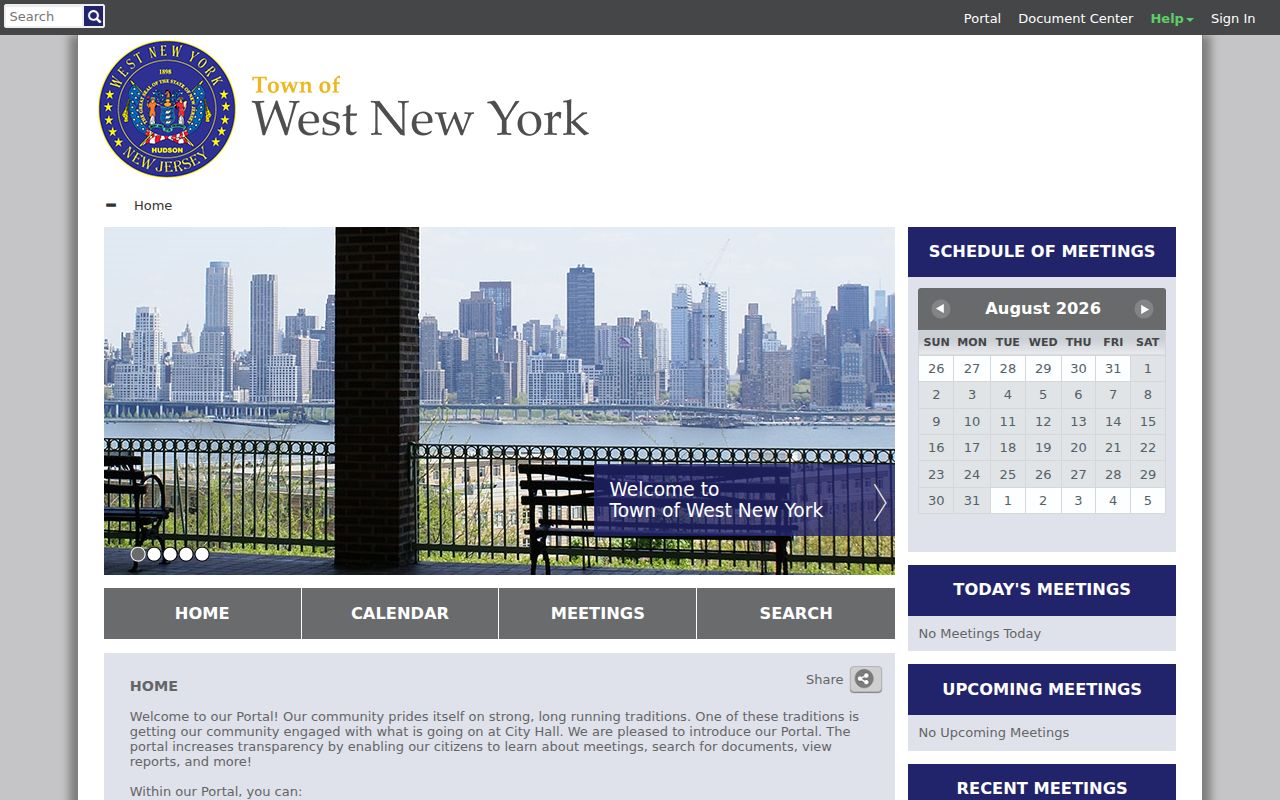
CivicWeb can put a West New York parcel or project into public municipal context. It is not a resident index. A document should be read for its date, parcel reference, and stated purpose before it is used as a block-research lead.
West New York Neighbor Myth
A recorded deed names transaction parties. It does not identify every West New York neighbor who lives at or near the property. The same distinction applies to assessment records, permit files, and map labels. These sources can create a lawful record trail, but every one has a specific administrative purpose. A name in a document must not be enlarged into a statement about a whole household or block.
For a property document, use the Hudson Register’s Legal Description search with West New York, block, lot, municipality, or address. Preserve the document type, party role, recording date, and legal description. If online detail is incomplete, the Register Public Search Room is the counter route for hard-copy indexes, filed maps, and copies. That is safer than filling gaps with a presumed neighbor identity.
West New York Neighbor Privacy
Private household members, utility and motor-vehicle information, and protected addresses are not a West New York neighbor lookup fallback. The New Jersey Address Confidentiality Program can provide a substitute address for qualifying participants. Daniel’s Law also drives redaction for qualifying people. Court rules and election statutes add their own protections. If a source omits a detail, do not combine fragments to reconstruct it.
The Hudson Register recording-alert service is the source for the opt-in monitoring screen shown below. It monitors a name only after enrollment, needs each name or business variation entered separately, and covers documents recorded after sign-up. It is a preventive notice tool, not a neighbor roster or a way to track people.
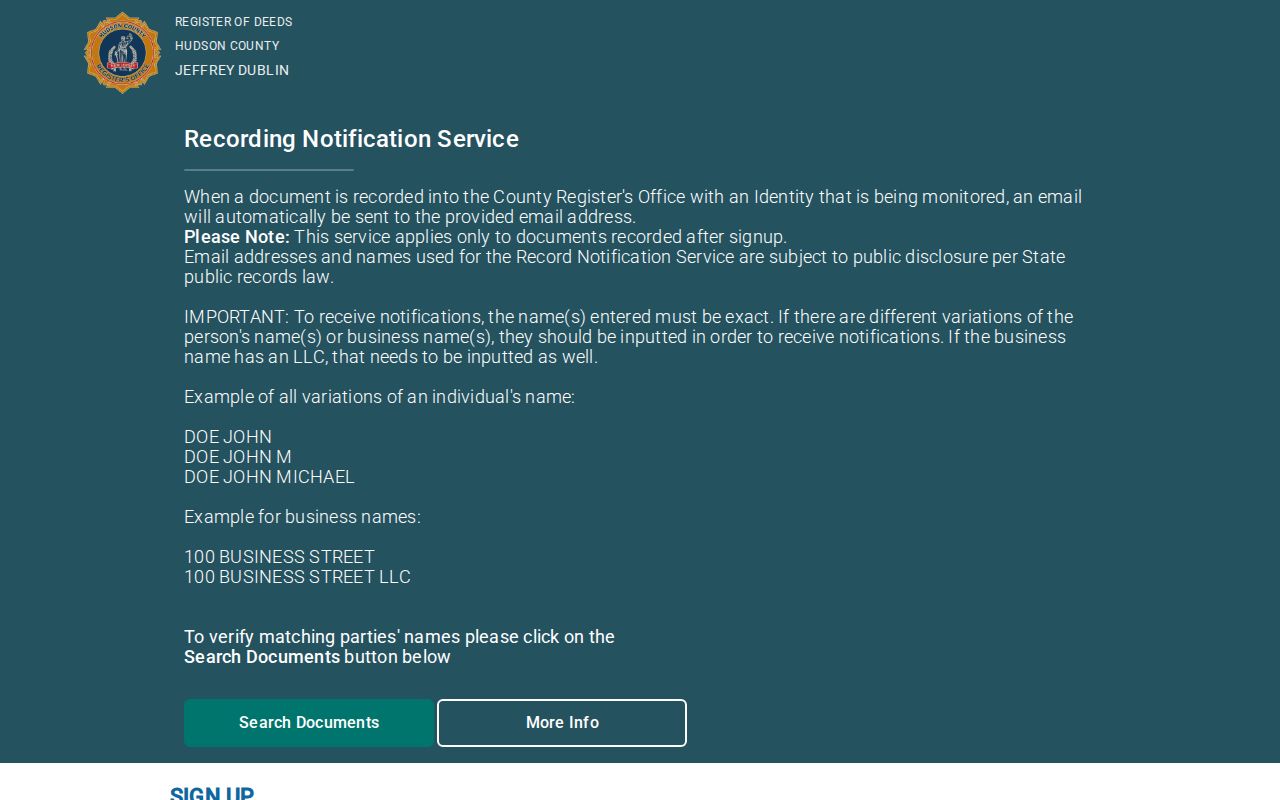
West New York block research should stop at the lawful record boundary. An alert can prompt a person to check a later recorded document with the Register, but the alert itself does not verify identity, occupancy, or property ownership.
Lawful use. Use West New York neighbor records for personal, lawful research and public civic context. Stalking, harassment, and intimidation are prohibited under New Jersey law.